

Few things are more unsettling than walking into your home and smelling sewer. The good news: the cause is often simple and cheap to fix. The bad news: sometimes it’s an early warning of a cracked or blocked sewer line.
Here are the seven most common causes we find in Tri-Valley homes, starting with the easiest.
1. A dry drain trap
Every drain has a U-shaped trap that holds a little water. That water blocks sewer gas from coming up the pipe. If a guest shower, basement floor drain or rarely used sink sits unused for a few weeks, the water evaporates and the gas comes straight in.
The fix: Run water in every drain for 30 seconds. If the smell fades within a day, that was it. Run unused drains once a week.
2. A failed toilet wax ring
The wax ring under your toilet seals it to the drain. When it fails, sewer gas leaks out around the base. You may also see a wobbly toilet, water stains on the floor or ceiling below, or caulk that’s pulling away.
The fix: Replace the wax ring and check the flange underneath. It’s a quick toilet repair, but a rocking toilet can crack the flange if it’s left too long.
3. Buildup inside the drain
Sometimes the smell comes from the drain itself. Hair, soap scum, food and grease decay inside kitchen and bathroom lines and smell a lot like sewer.
The fix: Clean the P-trap and the drain stopper. If the smell comes back quickly, the line may need professional drain cleaning. Related: Why does my kitchen sink keep clogging?
4. Your water heater (rotten egg smell from hot water only)
If the smell only shows up when you run hot water, the cause is likely your water heater, not the sewer. Bacteria in the tank react with the anode rod and make a sulfur smell.
The fix: Flushing the tank and replacing the anode rod usually solves it. Learn more about water heater repair.
5. A cracked or leaking sewer line
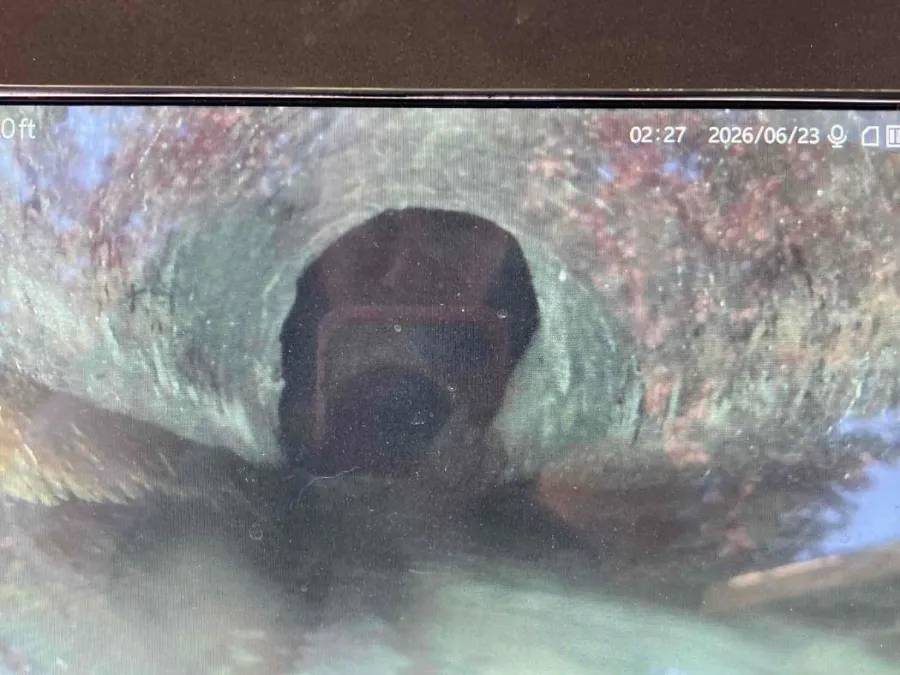
This is the one to take seriously. A crack, offset joint or root intrusion in the main sewer line can let gas and waste escape under the slab, in the crawl space or in the yard. Signs include:
- A sewer smell that won’t go away after you rule out traps and toilets.
- A smell that’s strongest near the floor, in the crawl space or near the cleanout outside.
- Soggy or unusually green patches in the yard.
- Slow drains throughout the house.
Many homes in Livermore, Pleasanton, Dublin and San Ramon were built in the 1960s through the 1980s with cast iron or clay sewer lines. Those materials crack, corrode and let tree roots in as they age.
The fix: A sewer camera inspection shows exactly where the problem is and how bad it is, so you can make a decision based on what’s actually in the pipe.
6. A dead animal or rodent
Not every bad smell is coming from the plumbing. A rat, mouse, squirrel or opossum that dies in the crawl space, attic or inside a wall gives off a strong, rotting smell that many people mistake for sewer. It’s especially common after rodent bait has been put out, or in fall and winter when animals move under houses to stay warm.
Clues it’s an animal, not the sewer:
- The smell is strongest in one room or along one wall, and doesn’t change when you run water.
- It gets worse over a few days, then slowly fades over a week or two.
- You’ve heard scratching, seen droppings or recently put out bait.
- Flies are gathering in one spot.
The fix: Call a pest control company to find and remove the animal and seal the entry point.
7. A sewer backup starting
If the smell comes with gurgling toilets or water rising in a tub or shower when you run other fixtures, the main line may be blocked. Stop using water and call a plumber. A backup gets worse with every flush.
When to call a plumber
Call us if:
- The smell is still there after you run water in every drain.
- More than one drain is slow or gurgling.
- You see water or sewage near the cleanout or in the yard.
- You’ve been told you need sewer work and want a second look before you decide.
How Barnett Plumbing helps
We start by finding the source, not guessing. That often means a camera inspection of your sewer line, so you can see the inside of your pipe on screen with us. Then we explain your options, from a simple sewer line repair to trenchless replacement, before any work starts.
Smell sewer in your home? Call us at (925) 872-0805 or book online.